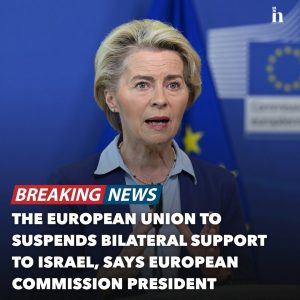
In a dramatic shift in EU policy, European Commission President Ursula von der Leyen announced on September 10, 2025, that the bloc will suspend bilateral support to Israel and propose sanctions on extremist Israeli ministers amid ongoing concerns over the war in Gaza. Speaking at a press conference in Brussels, von der Leyen stated, “We will put our bilateral support to Israel on hold. We will stop all payments in these areas, without affecting our work with Israeli civil society and businesses.” This move includes a partial suspension of the EU-Israel Association Agreement, which governs trade and cooperation, potentially impacting billions in annual exchanges. The sanctions target figures like Israeli Finance Minister Bezalel Smotrich and National Security Minister Itamar Ben-Gvir, accused of inciting violence against Palestinians.
The decision comes after months of internal EU debates, fueled by Israel’s military operations in Gaza, which have resulted in over 41,000 Palestinian deaths according to Gaza health officials, and widespread destruction. Von der Leyen emphasized that the measures aim to pressure Israel to comply with international law and halt actions exacerbating the humanitarian crisis. “The situation in Gaza is unacceptable,” she said, citing reports of famine and civilian suffering. The proposal has garnered support from member states like Ireland, Spain, Denmark, Sweden, and the Netherlands, who have long advocated for stronger action against Israel. However, it faces opposition from pro-Israel nations such as Germany and Hungary, highlighting the EU’s divided stance.
Insight into this development reveals deeper geopolitical tensions. The EU, Israel’s largest trading partner, has historically balanced strong economic ties with criticism of its policies in the occupied territories. This suspension could strain relations, potentially leading to retaliatory measures from Israel, which has already condemned the move as “unacceptable conduct between partners.” Analysts suggest it’s a symbolic gesture rather than a full embargo, as it spares civil society and key sectors like tech and agriculture. Yet, it signals a hardening EU position, influenced by growing public pressure and reports from groups like Amnesty International accusing Israel of genocide—a charge Israel vehemently denies.