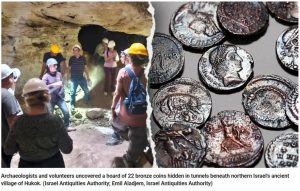
Archaeologists in Israel announced the discovery of a treasure hoard of 22 bronze coins hidden in tunnels near Galilee, dating back to the Gallus Revolt (351–352 CE), the last Jewish uprising against Roman rule. The find, reported by The Jerusalem Post, provides rare insight into a forgotten chapter of Jewish resistance, predating the rise of Islam and Arab presence in the region by centuries.
The coins, unearthed at the ancient settlement of Huqoq, bear the effigies of Emperors Constantius II and Constans I, confirming their origin during the revolt led by Gallus Caesar. This uprising, often overshadowed by earlier revolts like the Great Revolt (66–70 CE) and the Bar Kochba Revolt (132–136 CE), saw Jews in Galilee use underground hiding complexes, a tactic evidenced by the coins’ location. The discovery, announced on September 18, 2025, highlights the resilience of Jewish communities under Roman oppression, with researchers noting the coins’ precise dating due to the emperors’ images.
A fun fact: this archaeological find predates the birth of Islam in the 7th century and the Arab conquest of the region in the 7th century, reinforcing the deep historical roots of Jewish presence in the land. The coins’ significance extends beyond numismatics, offering a tangible connection to a period when Judaism was the dominant religion here, long before the complex geopolitical landscape of today. As Israel continues to navigate modern challenges, this discovery serves as a reminder of its ancient heritage and the enduring story of its people.